
If there's one thing everyone in the mental health field agrees on, it's that stigma must be stopped. Search "mental health stigma" on any platform and up will pop hundreds of talks, academic articles, and personal essays, most of which espouse the same three messages:
Stigma is bad.
It's bad because it prevents people from seeking help.
Education programs that teach "mental illness is a disease like any other" are the key to stopping stigma.
We can't argue with point 1. From a personal perspective, shaming or shunning people with disabilities or health challenges is unkind. From an organizational perspective, it's unproductive (not to mention illegal).
Points 2 and 3, though, are assumptions to be examined. Here's Natasha Tracy, author of the blog "Bipolar Burble," explaining why anti-stigma campaigns make no sense given that stigmatization is not what prevents people from seeking help. And here's Christy Smith writing for the Harvard Gazette about how "disease like any other" campaigns not only have failed to work, but in some situations have backfired.
In this issue of Mindfalls, we take on the puzzlingly intractable issue of stigma. Can we stop it? How? And should that even be the goal?


by Jocelyn Davis
“Did you feel like ... like a different person?"
I could hear a trace of anxiety in my former colleague's voice. He had called for some career advice, but he knew about my crazy episode, knew I was writing a book about it, and the conversation had turned to mental illness. What was it like? he wanted to know.
I was momentarily at a loss. "Hang on, just crossing a street," I said. I hurried across the intersection of Don Gaspar and Buena Vista, phone pressed to ear, trying to remember. Had I felt like a “different person” when I was mentally ill?
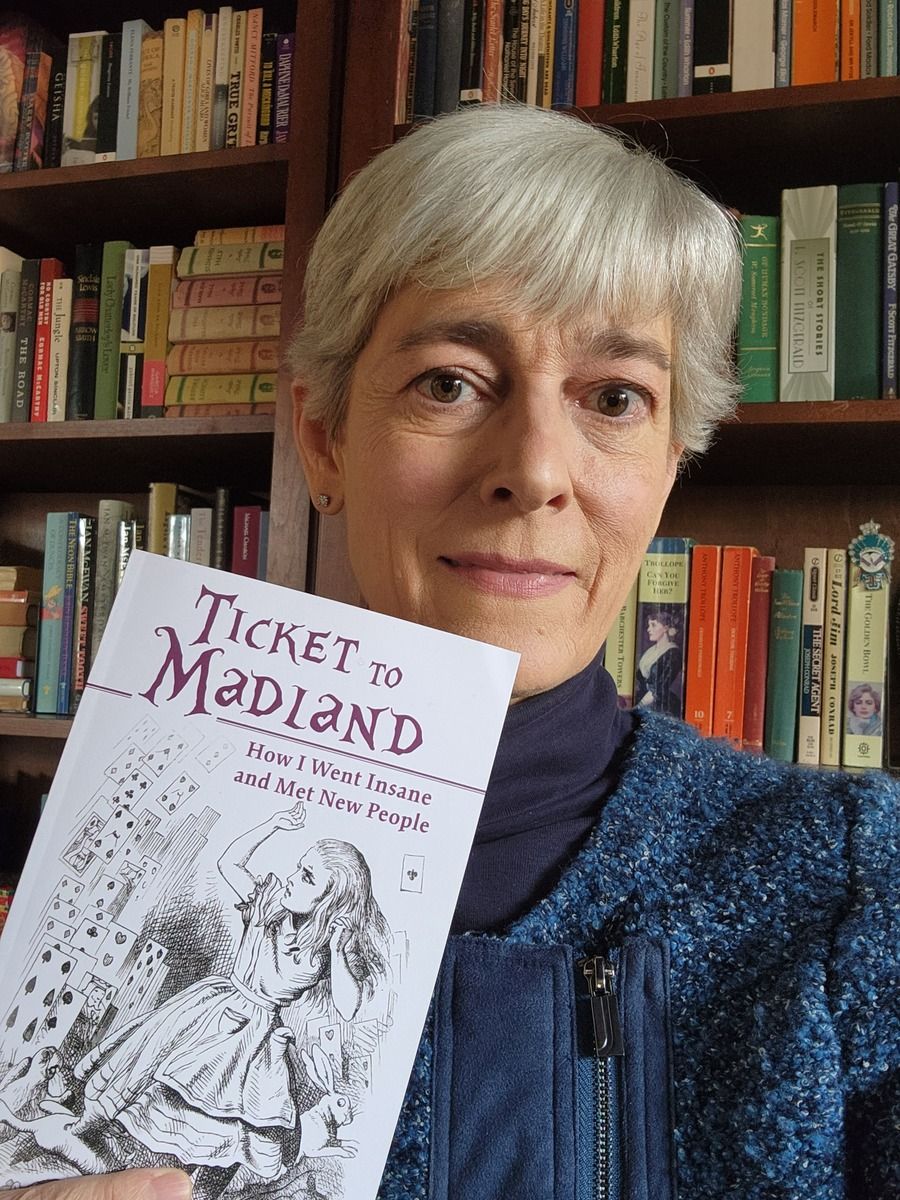
For Ticket to Madland, I had invented two characters, Sane Me and Mad Me, who acted as literary devices to illustrate the experience of losing one’s mind. After the book came out, more than one reader seemed inclined to interpret them as a Jekyll-and-Hyde duo, with Sane Me as the upstanding Dr. Jekyll and Mad Me as the monstrous Mr. Hyde. That hadn’t been my intent; I saw Sane Me as a kind of higher self, a guardian angel who was watching over me throughout my ordeal, while Mad Me was the terrified child-self who desperately needed watching over. But they weren’t separate people. Sane or mad, I was still me.
“No,” I said to my colleague. “I didn’t feel like a different person. I felt … I don’t know … just sick, I guess.”
“Oh. Huh.”
I’m certain he meant only sympathy, and I was grateful for his interest. Nevertheless, that “Oh. Huh” landed like a small, stinging drop of stigma. He clearly could not relate, and I did not know how to bridge the gap. Turns out, it’s a terribly difficult gap to bridge.


Jocelyn Davis writes books about leadership, history, literature, and mental health. Learn more at JocelynRDavis.com.

Madness is a Place
Ticket to Madland is the harrowing yet humorous story of my trek through a bizarre brain-body illness culminating with two weeks in a locked psych ward. “Reads like a medical thriller,” says one reviewer. (Spoiler: I recovered.)
This week, I’m sharing the book’s opening and closing paragraphs. Many thanks to the Muse for supplying the “country” idea. It worked out well. –Jocelyn Davis
Mental illness is another country. Like all countries it is populated, but in it you don’t meet people so much as encounter them: monsters in a fairy-tale forest.
“How curious,” you think as the monsters approach, noses snuffling, heads atilt. Some are belligerent, others calm. Some stare, others look away. Some have crisp white coats, stethoscopes, and an air of detachment; others have frazzled hair and a tendency to howl. While most keep a few paces distant, a few come close enough for you to touch—were it permitted. There are a lot of rules in Madland. “No touching” is one of the biggest.
Madland is separated from Saneland by a looking glass. At first the glass is permeable, gauzy, allowing you to go back and forth many times a day, but as time passes it thickens like gelatin, then like glue. Your own monstrous face confronts you as you push on the glass trying to return. Failing. Soon you start to wonder whether Saneland ever existed. You get used to the hopelessness, the way you can’t seem to walk in your intended direction no matter how resolutely you set off, so you decide it’s best simply to walk in circles or, finally, to drop to the ground and never move again. What’s the use, you think. There’s no way out.


The 2026 workplace mental health poll from Ipsos and the National Alliance on Mental Illness highlights a gap between growing awareness and real support. While most employees say mental health should be openly discussed at work, many still fear stigma or negative consequences for speaking up. Stress and burnout remain high, with some workers considering leaving their jobs as a result. Yet only about half feel their organizations truly prioritize mental well-being, and access to resources and training, especially for managers, remains limited. Overall, the report shows progress in conversation, but not enough action.
The article describes a growing mental health crisis affecting many Generation X women (those now in mid‑life), with about two‑thirds struggling with anxiety, depression, burnout, and a sense of losing themselves. Factors include life pressures such as menopause, caring for children and ageing parents, health issues, job stress, redundancy, and societal invisibility, which together erode wellbeing. Experts note that hormonal changes and a lack of awareness or support around menopause can worsen mental distress, while traditional healthcare often misinterprets women’s symptoms. The piece highlights how these intersecting pressures, combined with limited support, are pushing many Gen X women to a breaking point, even though their generation was once seen as poised to thrive.
The piece discusses how mental health stigma and discrimination go beyond simple negative attitudes, showing that harmful stereotypes and social exclusion are deeply intertwined with systemic biases and structural barriers. It explains that stigma isn’t just about individual prejudices; it’s reinforced by cultural, institutional, and policy‑level dynamics that together limit access to treatment, lower self‑esteem among people with mental illness, and worsen outcomes. The authors argue that reducing stigma requires multi‑layered change targeting personal beliefs, healthcare systems, and broader societal norms to truly improve support and equity for people living with mental health conditions.
The article argues that recent media coverage, specifically a BBC piece about doctors and “fit notes” for mental health, ends up reinforcing harmful stereotypes rather than informing the public accurately. Instead of offering balanced context, the coverage focused on rare negative behaviors and language like people “milking the system,” which fuels prejudice and mistrust toward those with mental health needs. The piece criticizes the lack of voices with lived experience and important data on unmet treatment needs, pointing out that such omissions contribute to stigma. It highlights how these kinds of portrayals can discourage people from seeking help, harm their chances of finding employment or housing, isolate them, and erode trust in health professionals, outcomes that serve no one well.

TEDx Talk: "Imagine There Was No Stigma to Mental Illness" (Dr. Jeffrey Lieberman). This is a good, comprehensive talk that also strikes me as quite naive. Dr. Lieberman subscribes to the disease model of mental illness, calling it "a medical condition just like any other." He might be right, but it doesn't follow that stigma will end once we all accept the disease model. For a counterpoint, read this article about a Harvard course called "Stigma, Discrimination, and Health," taught by Professor Mark L. Hatzenbuehler.
Book: The Mark of Shame: Stigma of Mental Illness and an Agenda for Change. Stephen P. Hinshaw examines the longstanding tendency to stigmatize those with mental illness and provides practical strategies for overcoming this serious problem, including social policies that encourage contact with those afflicted, media coverage emphasizing their underlying humanity, family education, and responsive treatment. Also check out Another Kind of Madness, Hinshaw's deeply personal memoir about his family's struggle with bipolar disorder.
Book: Cis White Gay: The Making of a Gender Heretic, by Ben Appel. Ben is a writer, commentator, and one of the 24 mental illness survivors we interviewed for our research. His 5-star memoir, which came out last November, tells how he grew up in a religious cult, developed a type of obsessive-compulsive disorder known as scrupulosity, became dependent on a variety of drugs, hit bottom (several times), got clean, got sucked into a new kind of cult at Columbia University, was "excommunicated" again ... and finally found true freedom on the other side of exile. His fascinating story kept me turning the pages and, more importantly, gave me a better appreciation of the battles that occur at the intersection of mental illness and addiction.
Presentation or Workshop: "Let's Talk Mental Illness: Stop the Stigma, Normalize the Conversation, Learn How to Help," by Jocelyn Davis. This is the slide deck for my anti-stigma mini-course for leaders at all levels. Free if delivered online; cover my expenses if you'd like me to come in person. Length: 1 hour as a keynote, 2 hours as a workshop.
The Mindfalls newsletter is for informational purposes and is not a substitute for professional help. If you are having a mental health crisis, call or text the 988 Suicide & Crisis Lifeline, reach out to your doctor, or go to the nearest emergency room.