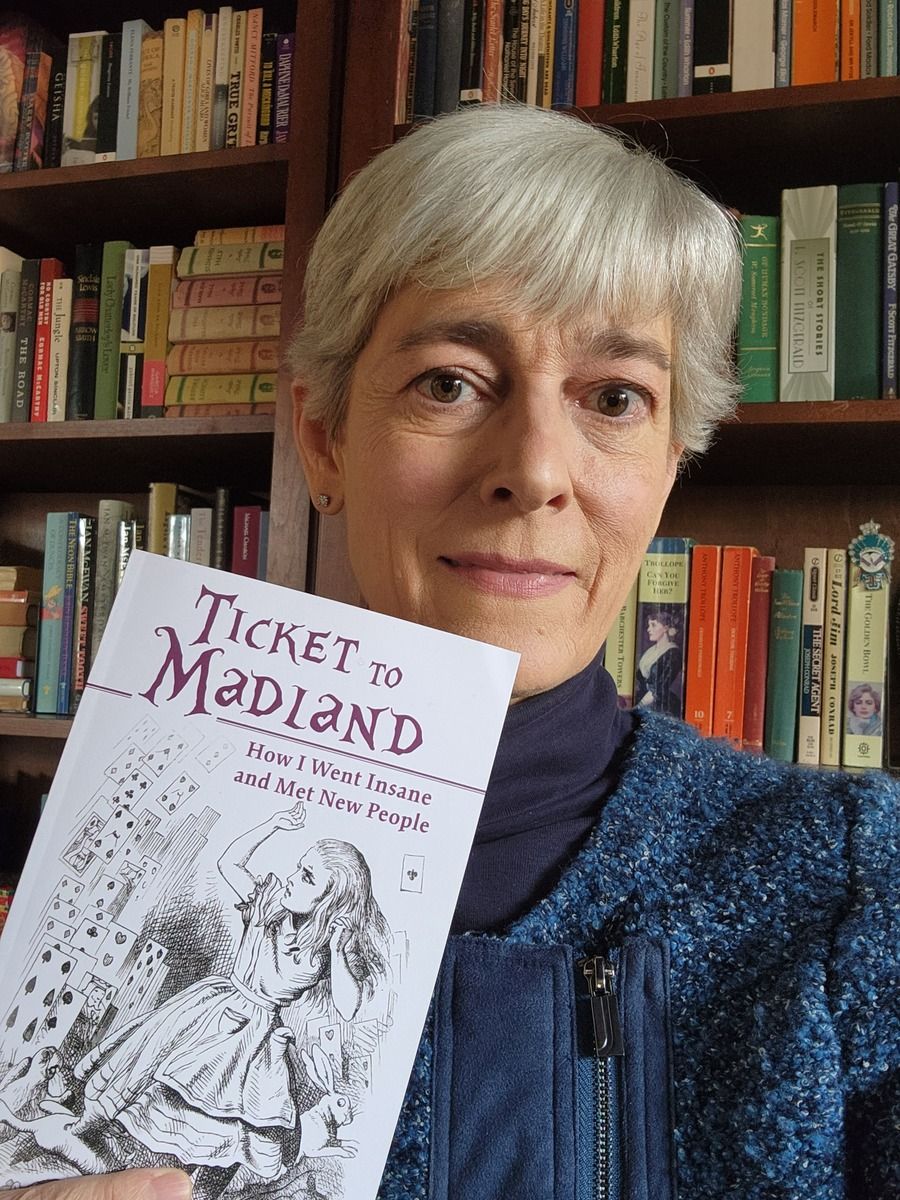
Ticket to Madland is the harrowing yet humorous story of my trek through a bizarre brain-body illness culminating with two weeks in a locked psych ward. “Reads like a medical thriller,” says one reviewer. (Spoiler: I recovered.)
This week, I’m sharing the book’s opening and closing paragraphs. Many thanks to the Muse for supplying the “country” idea. It worked out well. –Jocelyn Davis
***
Mental illness is another country. Like all countries it is populated, but in it you don’t meet people so much as encounter them: monsters in a fairy-tale forest.
“How curious,” you think as the monsters approach, noses snuffling, heads atilt. Some are belligerent, others calm. Some stare, others look away. Some have crisp white coats, stethoscopes, and an air of detachment; others have frazzled hair and a tendency to howl. While most keep a few paces distant, a few come close enough for you to touch—were it permitted. There are a lot of rules in Madland. “No touching” is one of the biggest.
Madland is separated from Saneland by a looking glass. At first the glass is permeable, gauzy, allowing you to go back and forth many times a day, but as time passes it thickens like gelatin, then like glue. Your own monstrous face confronts you as you push on the glass trying to return. Failing. Soon you start to wonder whether Saneland ever existed. You get used to the hopelessness, the way you can’t seem to walk in your intended direction no matter how resolutely you set off, so you decide it’s best simply to walk in circles or, finally, to drop to the ground and never move again. What’s the use, you think. There’s no way out.
I first glimpsed Madland in January 2018, entered it for real in July 2020, and left it (maybe permanently, maybe not) fifteen weeks after that. Up till that time I had been, to quote the words a doctor once wrote on my chart, “alert, cooperative, well-groomed.” A top-grade student with two master’s degrees. A successful business executive turned book author. A reliable woman with a loving family, kind friends, and ample resources. Sure, a couple of minor medical problems, bit of an anxious personality, occasionally prone to panic attacks, but overall in great shape, my act solidly together.
Then, at age 57 and with barely a warning, I found myself on a steam train to hell. The final weeks of that bouncing, shrieking, sleepless journey were crammed horizon to horizon with horror, stuffed wall to wall with suffering, filled hour by interminable hour with grinding, nauseating fear. I was insane. I was suicidal. It was excruciating.
“What caused this collapse?” you ask. “An infection? Genetic condition? Brain tumor?”
No, no, and no.
“Trauma, then. Something dreadful must have happened to you.”
Nope. This is not a trauma memoir, and although I did eventually receive a diagnosis for one of my more overt symptoms, the reasons for the psychiatric nosedive remain less than clear. When I asked the neurologist at the Mayo Clinic for a theory, he waved a hand and said, “You just got in a funk.” Well … having experienced the funk, I can offer a more complete account than that; nevertheless, all I can say with certainty about my trip to Madland is, I went.
I believe it’s the same for many, perhaps most, mental illnesses. One minute you’re riding your usual commuter train, preparing to get off at your usual stop, the weather fine, a pleasant evening planned; the next minute you’re disembarking onto a rain-slick platform in a strange city at night, your bags gone missing, your heart pounding, your cold clammy fingers clutching a ticket you don’t remember having bought. You’ve arrived in the Bad Place, the Unhappiest Place on Earth. Why? Who knows. How to get home becomes your all-consuming concern, but there is no map, no schedule, and no trains seem to be leaving. Worst of all, the people (monsters?) swarming past you in the station act as if there’s nothing wrong: they smile and offer to take your picture, tell you you’re looking well, and when you go to the traveler’s aid booth the friendly man-monster behind the glass indicates a QR code you can scan to find the local attractions. When you start to cry, he sighs and shoves a grubby sheaf of forms at you.
“What’s this?” you ask, sniffling.
“A contract,” he says, “promising you won’t throw yourself onto the tracks. It’s illegal in these parts, you know. Sign here, and here.”
It’s a bewildering, scary mess of a country, perhaps especially to those who haven’t been. Which brings me to this book’s three purposes: to demystify, destigmatize, and defang.
***
Here follows the story of my voyage to and through that other country. You can buy Ticket to Madland wherever books are sold. Here’s how it ends …
Mental illness is another country, a country full of curious, fabulous, thoroughly human monsters. Like Alice, I did not want to go among them, yet, “We’re all mad here” said the Cat, and an insanity excursion might be one we all must make at some point in our travels through this vast, baffling universe, lest we persist in the arrogant belief that we could never go zipping off to the Bad Place on a ticket we don’t remember having bought, that we could never be guest of honor at a Mad Tea Party. In truth, any of us may suddenly and inexplicably find ourselves running as fast as we can just to keep in one place, with the earth churning beneath our feet, a superior Caterpillar shouting “green, Denver, horse!” and a jovial Vaseline Man jogging alongside. Anyone might slip through the looking glass or down the rabbit hole. Anyone can take a wild ride to Madland.
I certainly don’t recommend it as something to do, but I’ll say this:
It is something to have done.
