“Did you feel like ... like a different person?"
I could hear a trace of anxiety in my former colleague's voice. He had called for some career advice, but he knew about my crazy episode, knew I was writing a book about it, and the conversation had turned to mental illness. What was it like? he wanted to know.
I was momentarily at a loss. "Hang on, just crossing a street," I said. I hurried across the intersection of Don Gaspar and Buena Vista, phone pressed to ear, trying to remember. Had I felt like a “different person” when I was mentally ill?
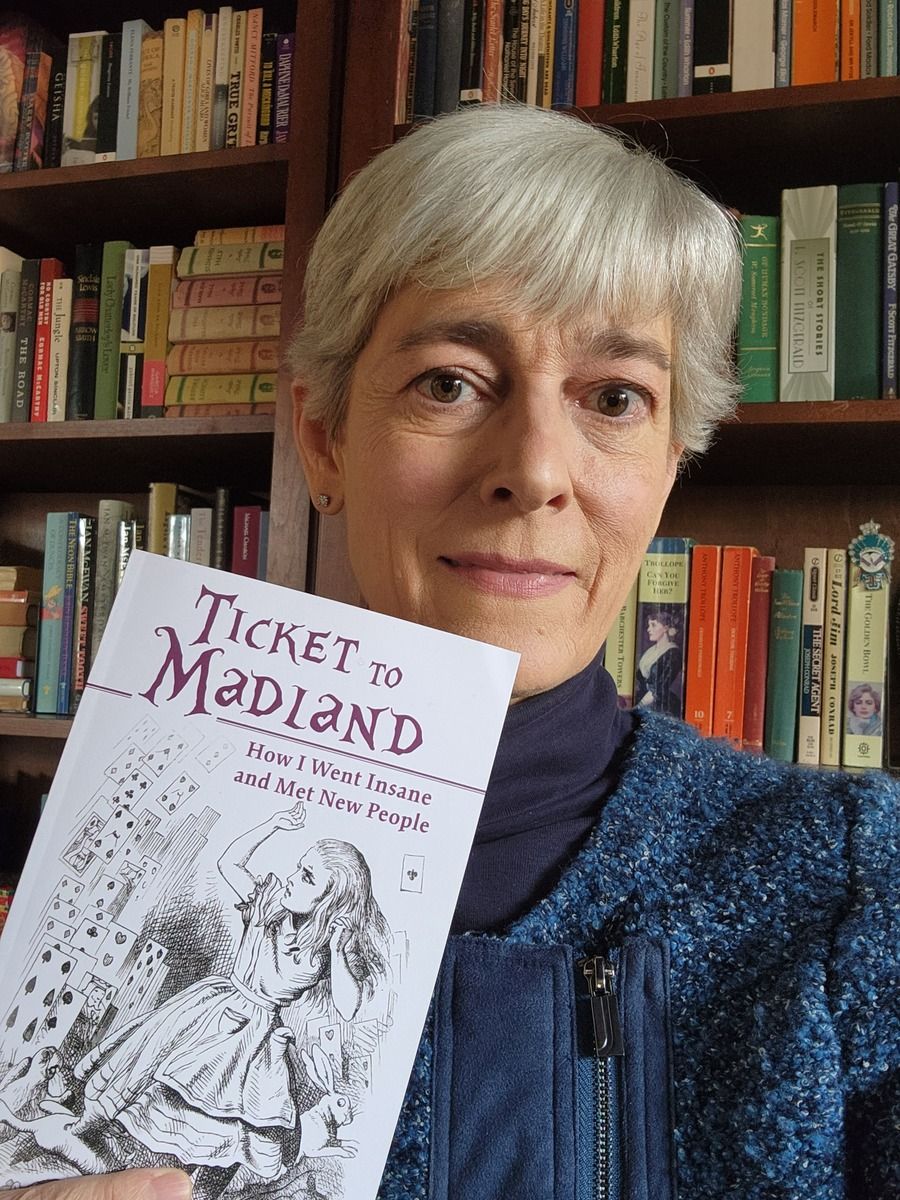
For Ticket to Madland I had invented two characters, Sane Me and Mad Me, who acted as literary devices to illustrate the experience of losing one’s mind. After the book came out, more than one reader seemed inclined to interpret them as a Jekyll-and-Hyde duo, with Sane Me as the upstanding Dr. Jekyll and Mad Me as the monstrous Mr. Hyde. That hadn’t been my intent; I saw Sane Me as a kind of higher self, a guardian angel who was watching over me throughout my ordeal, while Mad Me was the terrified child-self who desperately needed watching over. But they weren’t separate people. Sane or mad, I was still me.
“No,” I said to my colleague. “I didn’t feel like a different person. I felt … I don’t know … just sick, I guess.”
“Oh. Huh.”
I’m certain he meant only sympathy, and I was grateful for his interest. Nevertheless, that “Oh huh” landed like a small, stinging drop of stigma. He clearly could not relate, and I did not know how to bridge the gap. Turns out, it’s a terribly difficult gap to bridge.
Why Do We Stigmatize?
Stigma toward the mentally ill, according to this smart guy on YouTube, has three causes: perceived peril, perceived origin, and perceived course instability. Fear underlies each.
Perceived peril. The mentally ill are seen as dangerous, erratic, possibly violent. Best to give them a wide berth, for who knows when the good Dr. Jekyll might transform into the evil Mr. Hyde? And even when there’s no obvious threat of violence, we may worry about contagion. Our conscious brain knows mental illnesses aren’t spread like the flu, but our lizard brain is a fan of the old “miasma” theory of disease. It backs away from any ooze of unhealthiness it sees seeping toward it, for fear of getting slimed.
If we manage to suppress the fear of violence and fear of contagion, there’s still the fear that we might say or do “the wrong thing” and make the situation worse. The concept of “triggers” has cranked up this third fear, rendering it in some cases a self-fulfilling prophecy: if someone believes certain words will damage their psyche, they might actually feel worse upon hearing those words. They might even blame us for harming them! Maybe, we think, it’s best to say nothing. *1
Perceived origin. Popular opinion has it that there are two non-overlapping origins of mental illness. Both can lead to stigma. According to one theory, mental disorders are biological disorders (think major depression, bipolarism, and schizophrenia). People suffering from these “diseases like any other” are thought to have something inherently wrong with their brains: they were born that way. Obviously an inborn malady isn’t their fault, so we sympathize—or at least, we don’t judge them. The disease model, however, can feed the sense of peril described above, because people with incurable illnesses seem alien: “not like us.” We may sympathize, but we may also recoil from the weirdness.
The other origin theory says that the mentally ill have been adversely affected by circumstances: nothing inherently wrong with them, they’ve just been knocked off balance by bad luck of one kind or another. Or maybe it wasn’t bad luck—maybe it was bad choices or habits, in which case (we think) they’ve only themselves to blame.
Take Alicia *2, my 26-year-old roommate at the rehab facility where I made a brief stay. Her boyfriend, she told me, had supplied the on-ramp for her meth habit, presenting her with a substitute for cocaine that was “a lot cheaper and an even better high.” She jumped at the offer. Soon she was snorting meth, injecting heroin, swallowing Xanax in order to sleep, and suffering from full-blown depressive episodes. During one, she slashed her wrists. Knowing traumatic stress can contribute to substance use disorder, I asked about her past: her life, she said, had been pretty normal, her family loving and supportive. I did not fault Alicia for her struggles. I also liked her. Nevertheless, I couldn’t help thinking she’d been very silly indeed.
Perceived course instability refers to how we see a health problem progressing. If it’s expected to be temporary and curable, or at least predictable, we’re reassured; if chronic and incurable, or simply unpredictable, we’re uneasy. There’s nothing scarier than the unknown, and alas, mental illnesses contain a large element of unknowability: no biomarkers to diagnose them, no way to predict with confidence how they will develop, no way to know for sure whether a particular treatment will help a person or not. If we can’t foresee the outcome, maybe we shouldn’t bring it up. Close eyes, cover ears, la-la-la-la-la.
The same used to be true of cancer: I recall my grandmother whispering the word as if speaking it aloud might summon a demon. Now that we have more reliable cancer treatments, we’ve grown much more comfortable talking about it. Mental illness, though? We’re still whispering about that.
Stigma Is Stubborn
You can see why mental illness stigma is so stubborn. The course of psychiatric disorders is by nature unpredictable, and while treatments have improved in recent years, they’re still a long way from the reliability of, say, treatments for heart disease. No one can agree on whether the origin of mental illness is organic or circumstantial, and either way, stigma seems unavoidable: if your illness is organic, you’re a leper, and if it’s circumstantial, well, we all face difficulties and the rest of us manage to cope, so why can’t you?
Peril is a bit more open to education: some studies show that when we spend time with people who’ve experienced mental illness and get to know their stories, our sense of danger lessens. “While social contact may involve correcting misinformation,” says the World Health Organization, “the focus is on changing attitudes … Often, this involves having someone share their experiences of living with a mental health condition, balancing frank descriptions of past suffering with clear demonstrations of recovery and resilience.”
Still, the get-to-know-a-friendly-nutcase approach can backfire, too. Some of my close friends and family members, despite or maybe because of knowing me well, seem to have trouble believing I was ever really insane. “But you had a physical problem,” say some. *3 “But you just went through a bad time,” say others. Yes, I had some physical problems, and yes, I went through a bad time. But also, I was loony tunes. Most folks can’t square that fact with the observation that I was, and am, perfectly normal. How can a lunatic be normal? It makes no sense.
Here’s how I see it: I went to hell and returned, with scars, but still me. And that perspective, I believe, is the key to reducing stigma.
Let’s Reframe
I propose a reframing of mental illness. Instead of thinking of it as who you are or what you have, let’s think of it as where you find yourself. In other words, let’s regard it not as a person, not as a thing, but as a place.
This thought first occurred to me back in 2023 when I decided to write about my mental health journey. I’m a workaday sort of author, more the crank-it-out type than the wait-for-inspiration type, but I do like to begin the book writing process with a half-assed invocation of the Muse for a first sentence. In this case, the line the Muse threw at me was:
Mental illness is another country.
I was skeptical. Wasn’t that the title of a movie? Another Country. No Country for Old Men. A Month in the Country. Something like that. I didn’t want to copy (too blatantly), and anyway, what did it even mean? Nevertheless, I decided to give it a try and see what emerged.
As it turned out, that line was the key to the whole effort. Thinking of my illness as a voyage to a strange land—Madland, I called it, where I was stuck for a while but from which I was ultimately able to return—gave me the foundation for the story and allowed me to write with empathy for myself as well as for the fellow travelers, guides, and hoteliers whom I met along the way. The “other country” concept inspired not only the opening and closing paragraphs (see this week’s book excerpt) but also the Alice in Wonderland motif, which worked, if I may say so, extremely well.
If you think the place reframe is worth a try, here are three ways to put it into action:
If you’re someone living with mental illness, know that severity does not predict duration. It is entirely possible to travel to a far-off land, even a very inhospitable one, and return safely. Maybe you’ll be there for weeks or months. Maybe you’ve lost your passport and all your luggage. Maybe the weather is horrible and the motel has roaches. Maybe you’ve been there before, once, twice, or a dozen times. Despite all this, you are neither broken nor damaged—just temporarily stuck. Sooner or later, with help, you will get unstuck and get home.
If you’re a friend or family member, talk to your loved one as you usually would—they’re still the same person, after all—but be aware that your voice will sound to them as if it’s coming from a great distance. It takes a ton of effort just to hear you and decipher what you’re saying, let alone speak back loud enough to be heard. Kelly describes it thus: “It’s like I was at the bottom of a deep, deep well, and people were shouting down at me from the top.” Picture that well. Or imagine you’re living in the days when long-distance calls were dreadfully expensive, and you’re making collect calls. Keep calling, but let your struggling loved one decide when and how to accept the charges.
If you’re a manager or colleague, think of an episode of mental illness as if the person were on an especially tough assignment—maybe a stint with an undercover investigative unit or an exploratory mission to a new market. Or maybe they’re in the National Guard and have been called up for service in a disaster zone. They’ll be out for a while, unreachable, doing who knows what for who knows how long; in all likelihood, however, they will return, stronger for the experience. They’ll be more resilient. More agile. Less perturbed by corporate fusses and feuds. With someone who has walked through minefields, you don’t have to walk on eggshells.
“Did you feel like a different person?” my colleague asked. I didn’t know what to say then, but I do now.
“No, I felt I was in a different country,” I’d say. “I was scared I’d be stuck there forever. But I found the way home.”
Jocelyn Davis and Kelly Kinnebrew, PhD, are researching a book on high-functioning professionals who have recovered from serious mental health collapses.
¹ We urge you not to buy this line of thought, for there is no research indicating that well-intentioned communication, even of a clumsy kind, can make a sick person sicker, while there is plenty of research showing that social connection, even in small doses, helps people stay healthy. As I frequently tell people worried about saying “the wrong thing” to someone in distress: It doesn’t matter what you say, it matters that you said it.
² Not her real name.
³ Even Paula, the group counselor in the psych ward where I was confined, seemed to buy into the physical vs. mental dichotomy. “Jocelyn has a medical condition,” she said. She was referring to my persistent vertigo, which was indeed part of the problem but by no means the whole problem. Had I been one of the other patients, who I guess in Paula’s view were just inexcusably bonkers, I would have resented that remark.